What will future Nobel Prizes be awarded for?


An internal OpenAI model recently produced ten new results across pure mathematics and theoretical computer science. The tokens required to find them would cost roughly $2,000 at GPT-5.6 Sol API rates.
The largest expansion of scientific discovery in human history is already underway. The constraint has always been capacity: the number of minds, the hours in a day, the length of a single career.
That constraint is dissolving.
This week, an OpenAI model cracked several math problems. One was about the best way to pack spheres in high dimensions, a problem no one had improved on since 1978. The model then translated each proof into a form a computer could check line by line, confirming the work held up.
In a separate effort, a Stanford-led reserach team used genome language models called Evo to write complete genomes for bacteriophages, modeling them on ΦX174, a phage that naturally infects E. coli. A bacteriophage is a virus that infects bacteria. The name means "bacteria eater."
Humanity spent roughly 50 years learning to read the code of life and 10 learning to edit it with tools like CRISPR. Now we are learning to write it.
This power cuts both ways.
The same model that could design a phage to defeat drug-resistant bacteria could also design something harmful. The task ahead is responsible deployment: moving fast enough to save lives, and carefully enough to protect them.
Handled well, the upside is historic.
In 2024, the Physics Prize went to John Hopfield and Geoffrey Hinton for the foundations of machine learning, and the Chemistry Prize went to David Baker, Demis Hassabis, and John Jumper for computational protein design and structure prediction.
These were the first Nobel Prizes to emerge from the age of AI. More will follow.
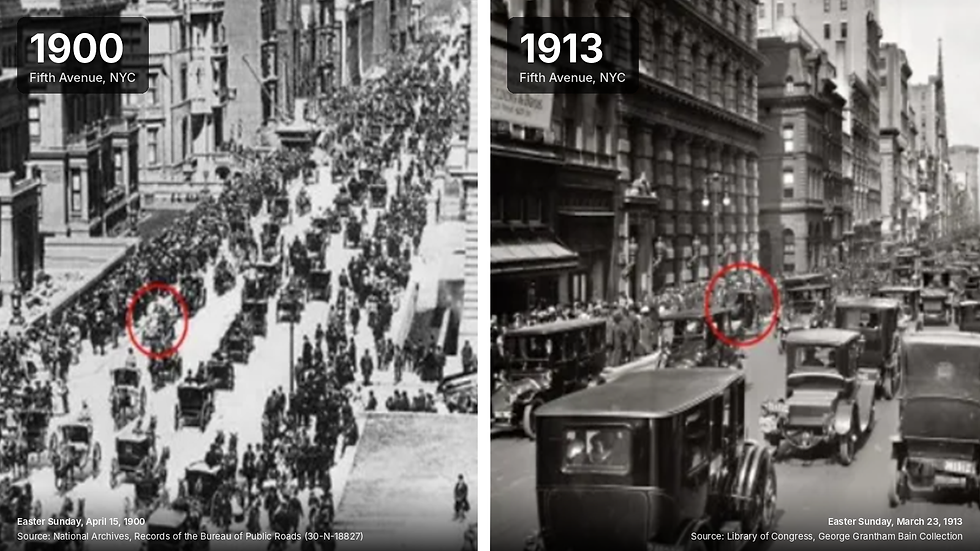
Exponential change creates enormous advantages for those who recognize it early. The ability to understand and apply these technologies may become one of the defining divides of this century.
In 1956, the Nobel Prize honored a switch that made modern computing possible.
That switch led to the device in your pocket. We now carry the power of 1,000 PhDs in our pockets. It is available to anyone with curiosity, a consequential question, and the discipline to pursue an answer.
The next Nobel-worthy discovery may begin in a university lab, a startup, a hospital, a garage, or a conversation with an AI.
Until next time,
Ram
—
Ram Srinivasan
MIT Alum | Author, The Conscious Machine | Global Future of Work and AI Adoption Leader published in Business Insider, Fortune, Harvard Business Review, MIT Executive Viewpoints and more.
—
A Message From Ram:
My mission is to illuminate the path toward humanity's exponential future. If you're a leader, innovator, or changemaker passionate about leveraging breakthrough technologies to create unprecedented positive impact, you're in the right place. If you know others who share this vision, please share these insights. Together, we can accelerate the trajectory of human progress.
Disclaimer:
Ram Srinivasan currently serves as an Innovation Strategist and Transformation Leader, authoring groundbreaking works including "The Conscious Machine" and the upcoming "The Substrate Shift."
All views expressed on "Substrate" and across all digital channels and social media platforms are strictly personal opinions and do not represent the official positions of any organizations or entities I am affiliated with, past or present. The content shared is for informational and inspirational purposes only. These perspectives are my own and should not be construed as professional, legal, financial, technical, or strategic advice. Any decisions made based on this information are solely the responsibility of the reader.
While I strive to ensure accuracy and timeliness in all communications, the rapid pace of technological change means that some information may become outdated. I encourage readers to conduct their own due diligence and seek appropriate professional advice for their specific circumstances.