Will AI eliminate more jobs than it creates?

Will AI eliminate more jobs than it creates? It’s the question I get most. McKinsey Global Institute (MGI)’s new report provides fascinating insights.
For the US through 2035, their base case ->
-> Automation could reduce demand by ~36M jobs
-> Growth could ADD 41M
-> Net: about 5M MORE jobs
Most of the growth is familiar work getting bigger:
1\ Rising living standards: +18M (services, hospitality, training)
2\ An aging population: +8M (care, health, home support)
3\ Construction and energy: +5M (skilled trades)
4\ The tech economy and its physical backbone: +5M
5\ Brand-new occupations: 500K - 2M

MGI traced 175 years of US employment. Today roughly 1/3rd of all American jobs exist because of steam, electricity, engines, telecom, computers and the internet. 1/5th came from rising incomes turning informal work into professions.
Software developer, security analyst, personal care aide and other categories all started small and took decades to scale.
MGI points to where more could emerge: agent engineering, workflow design, AI governance, human oversight, evaluation.
This is already happening:
-> Creators: US creator jobs went from +200K in 2020 to 1.5M in 2024
-> Storytellers: LinkedIn postings mentioning “storyteller” doubled in a year to +70K.
-> Forward deployed engineers:up +1,000% year over year, median base +$170K
-> Robotics Technician: a brand-new US Army specialty, activated October 1
Ten years ago, many of these may not have been on anyone’s career map.
Zoom out.
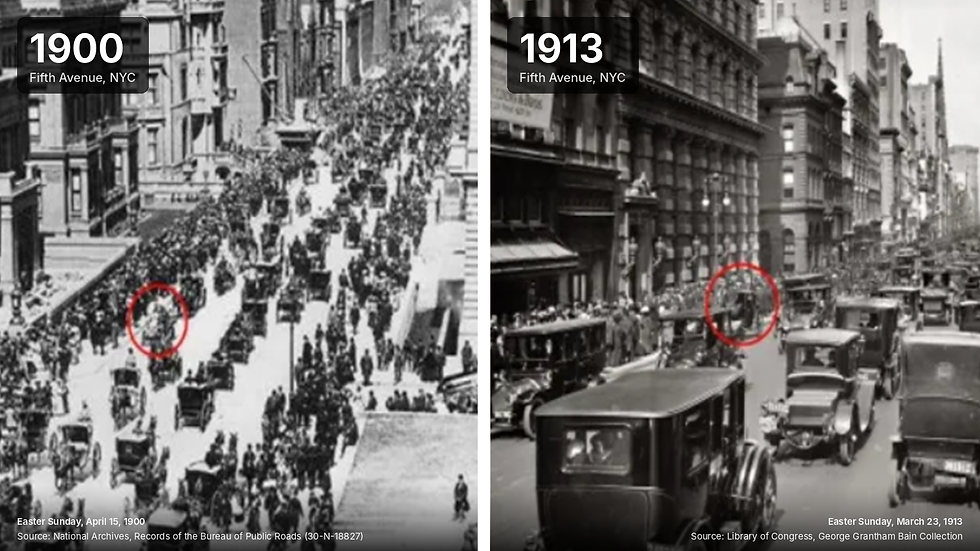
In 1900, Fifth Avenue was full of horses. By 1913, it was full of cars.
Within a generation, auto mechanic, chauffeur and pilot went from almost nonexistent to everyday jobs. MGI counts them among the occupations the combustion engine created.
That shift showed up first in a few cities. Much of the world took another decades to catch up.
We are seeing the pattern today, just MUCH faster.
The car took decades to reshape work. AI could do it in a few years. And with recursive self-improvement (RSI) and artificial superintelligence (ASI) now part of serious conversations, the questions get bigger:
-> What happens to work when machines can improve themselves?
-> What will we do in a world with superintelligent machines?
-> Which human roles become more valuable, and which ones haven’t been invented yet?
No forecast, including MGI’s, can fully model that. For me, history still offers a clue: every leap in capability has expanded what humans set out to do.
The harder question is mobility.
MGI estimates ~11M workers may need to switch occupations entirely BUT only 1 in 7 has a direct path into a growing job.
So the jobs may be there, but getting people TO them is the work. For leaders, the BIG question: are you building the pathways into these roles now?
Every leap in capability has expanded what humans set out to do. Super Intelligence may be the BIGGEST expansion yet.
Let’s start building the roads to it.
Until next time,
Ram
—
Ram Srinivasan
MIT Alum | Author, The Conscious Machine | Global Future of Work and AI Adoption Leader published in Business Insider, Fortune, Harvard Business Review, MIT Executive Viewpoints and more.
—
A Message From Ram:
My mission is to illuminate the path toward humanity's exponential future. If you're a leader, innovator, or changemaker passionate about leveraging breakthrough technologies to create unprecedented positive impact, you're in the right place. If you know others who share this vision, please share these insights. Together, we can accelerate the trajectory of human progress.
Disclaimer:
Ram Srinivasan currently serves as an Innovation Strategist and Transformation Leader, authoring groundbreaking works including "The Conscious Machine" and the upcoming "The Substrate Shift."
All views expressed on "Substrate" and across all digital channels and social media platforms are strictly personal opinions and do not represent the official positions of any organizations or entities I am affiliated with, past or present. The content shared is for informational and inspirational purposes only. These perspectives are my own and should not be construed as professional, legal, financial, technical, or strategic advice. Any decisions made based on this information are solely the responsibility of the reader.
While I strive to ensure accuracy and timeliness in all communications, the rapid pace of technological change means that some information may become outdated. I encourage readers to conduct their own due diligence and seek appropriate professional advice for their specific circumstances.