The AI Revolution Is Not About AI


Johann Wolfgang von Goethe wrote those words more than two hundred years ago, in 1825. They read as though they belong on today’s front page.
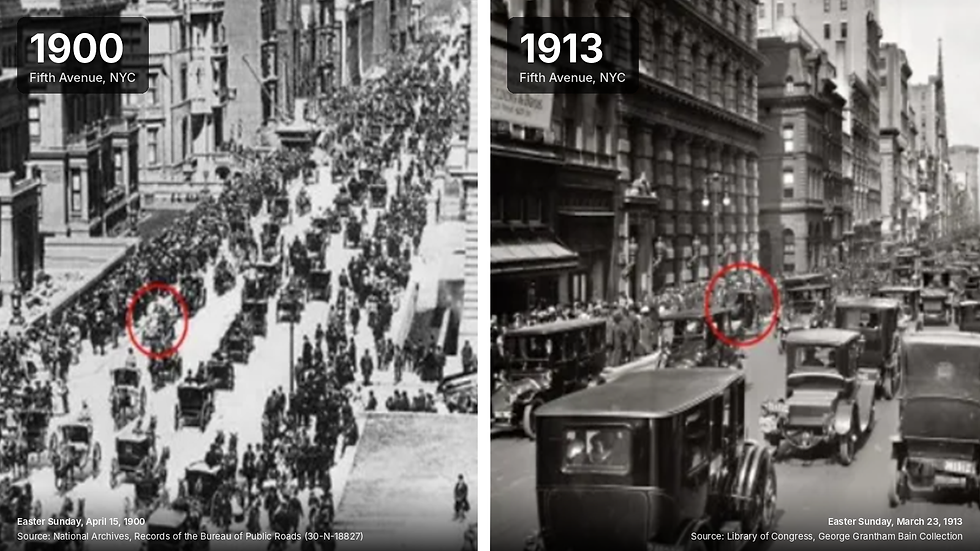
Goethe lived through a major technological transformation as Europe accelerated into the Industrial Revolution. Railways compressed geography, steamships collapsed oceans, and new communication systems reorganized commerce and culture. The world was moving faster than any previous generation.
Most saw inventions. Goethe recognized a deeper structural shift.
He understood that technological acceleration reshapes more than industry. It alters social rhythms, institutional expectations, and generational experience for those coming of age within it. And importantly, young people inherit systems whose rules are changing before they have time to master them.
Two centuries later, artificial intelligence is expanding those same dynamics at a FAR greater scale and MUCH faster.
AI systems now write production software, accelerate drug discovery, generate films, assist scientific research, and reshape education. Capabilities that once felt distant now arrive with remarkable speed and consistency.
Industry adoption is scaling alongside capability.
Amazon saved 4,500 developer-years and $260 million modernizing Java systems with AI. IKEA reskilled 8,500 customer service agents and generated roughly $1.4 billion in new remote design revenue. JPMorgan increased fraud detection speed by roughly 300 times, pushing AI-driven value toward $2 billion. Roche is building an AI infrastructure with more than 3,500 Nvidia GPUs to accelerate drug development. A mathematician working with an AI system produced a counterexample to the Jacobian conjecture, an 87-year-old conjecture during the FIFA World Cup Finals.
No single breakthrough defines the moment. Their convergence and amplification expand the cone of possibility.
AI expands the frontier of what individuals and organizations can accomplish. The cost of intelligence is falling, and capability is compounding across domains. A ten‑point gain in IQ is a major life advantage. A hundred‑point gain borders on the unimaginable. Terence Tao is often cited around 200, and his work illustrates what that level of ability can unlock.
Stretch that thought experiment further. At 500, we are in territory we can barely describe. AI is pushing us toward a world where, for specific problems, individuals can tap something that feels like those extra hundreds of points on demand. At that point, intelligence is no longer the primary scarcity. The bottleneck becomes what we choose to ask, where we direct that power, and which problems we decide to solve.
Every technology boom eventually shifts the bottleneck. In the internet era, scarcity moved from bandwidth to attention and intent. In the AI era, scarcity will move from raw intelligence to the quality of questions, goals, and designs that harness it. As intelligence becomes abundant, the hard part becomes deciding which signals to follow and which opportunities to pursue.
Even for those immersed in the field, tracking material developments has become difficult. Each morning brings another model, another benchmark, another paper, another system that extends capability.
The pattern now carries more signal than any individual headline.
Sam Altman recently suggested that we may have entered the singularity. The singularity is a period when runaway technological growth fundamentally transforms human civilization. Whether that characterization holds matters less than the observable shift in pace. Intelligence is becoming more abundant, and its effects propagate across industries at the same time.
This is the defining feature of the moment. The conditions through which intelligence is created and applied are becoming more accessible, more scalable, and more widely distributed.
That dynamic sits at the center of my next book, The Substrate Shift. By substrate, I mean the underlying layer of capabilities and constraints that shapes what is possible to build, how quickly ideas compound, and how societies organize around them.
The focus is not on AI as a tool but on the recurring pattern that defines how humans respond to changes in underlying conditions. It examines how work, institutions, and creativity reorganize during periods of technological acceleration.

History shows that these transitions feel unstable while they unfold and become legible over time. Each shift reorganizes opportunity in ways that resist early prediction. The details differ across eras, but the structure repeats.
When the substrate changes, the set of viable possibilities expands with it.
AI represents a shift in the conditions through which humans create, discover, and organize society. Individuals and institutions that recognize this dynamic gain leverage from it and help shape what comes next.
Goethe recognized the pressures created by acceleration and the strain it placed on individuals and institutions. Historical experience also shows that societies adapt, build, and extend the systems they create.
Every generation inherits an unfinished civilization.
This generation has inherited an extraordinary set of tools that make intelligence increasingly accessible and actionable.
The opportunity is to build with them at a scale and speed that was previously out of reach.
History suggests that this is exactly what happens next.
Until next time,
Ram —
Ram Srinivasan
MIT Alum | Author, The Conscious Machine | Global Future of Work and AI Adoption Leader published in Business Insider, Fortune, Harvard Business Review, MIT Executive Viewpoints and more.
—
A Message From Ram:
My mission is to illuminate the path toward humanity's exponential future. If you're a leader, innovator, or changemaker passionate about leveraging breakthrough technologies to create unprecedented positive impact, you're in the right place. If you know others who share this vision, please share these insights. Together, we can accelerate the trajectory of human progress.
Disclaimer:
Ram Srinivasan currently serves as an Innovation Strategist and Transformation Leader, authoring groundbreaking works including "The Conscious Machine" and the upcoming "The Substrate Shift."
All views expressed on "Substrate" and across all digital channels and social media platforms are strictly personal opinions and do not represent the official positions of any organizations or entities I am affiliated with, past or present. The content shared is for informational and inspirational purposes only. These perspectives are my own and should not be construed as professional, legal, financial, technical, or strategic advice. Any decisions made based on this information are solely the responsibility of the reader.
While I strive to ensure accuracy and timeliness in all communications, the rapid pace of technological change means that some information may become outdated. I encourage readers to conduct their own due diligence and seek appropriate professional advice for their specific circumstances.