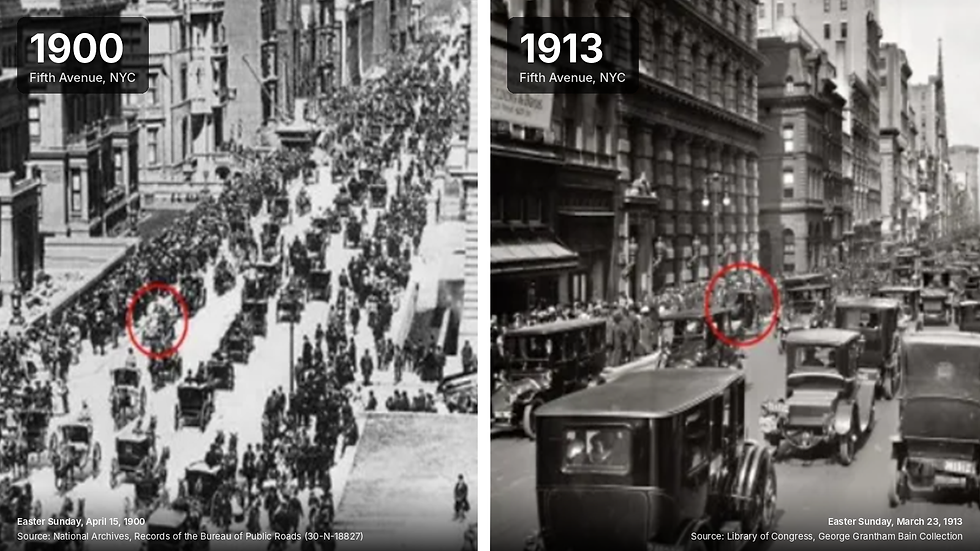
The AI-Dependent Workforce


TL;DR: The gap between the heaviest enterprise AI users and everyone else more than tripled in five months. During the same period, thousands of companies learned how much productive capacity can disappear when a critical AI vendor goes offline. The risk is that companies may become AI-dependent faster than they develop the human and institutional capability to govern that dependence. The companies that close that gap will own one of the defining advantages of the next decade: machine-scale output combined with human-grade judgment.
UPDATE September 03, 2026: As this essay was being prepared, ChatGPT, Grok, and Claude all went down at the same time with many users reporting issues.
THE WORK IS LEAVING YOUR DESK
In early March, Anthropic’s Claude experienced repeated outages over two days. Developers flooded Reddit and Discord with jokes about returning to manual coding. One developer wrote, “I guess I’ll write code like a caveman.” Another said the outage “hit way harder when you realize you’ve outsourced half your brain to it.”
A senior AI engineer said he did not even attempt to code manually because working without AI felt slower than waiting for the service to return.
The outages offered a visible reminder of a less visible risk: when teams embed a third-party model deeply into daily engineering workflows, a vendor disruption can immediately reduce productive capacity.
Claude went down again on June 2. The jokes returned. The underlying dependency had deepened. The outages expose how quickly AI is moving from software tool to operating infrastructure.
The enterprise data shows the same acceleration. OpenAI’s enterprise signals data report found that “frontier firms” (defined as the top 10% of enterprise customers by AI usage each month) generated 2.6 times as many output tokens per active user as typical firms in January. By June, the figure had reached 8.3 times.

The gap more than tripled in five months.
Codex alone represented 64% of combined enterprise output by June. AI-generated work has expanded well beyond engineering into legal, sales, recruiting, marketing, and other knowledge functions.
The leading organizations are building extraordinary productive leverage.
The talent implications are equally large.
For most of human history, people developed expertise by doing the work. I started my career in audit and tax, where I learned by tracing variances, checking source documents, reconciling discrepancies, investigating exceptions, and writing memos. The work created the mental models that later allowed me to exercise judgment.
The production process served as the training process.
That relationship has existed across nearly every profession. For example, doctors learn through cases, lawyers learn through matters, engineers learn through systems, accountants learn through reconciliations and managers learn through decisions.
AI is now automating large parts of the production process.
Companies therefore face a new question: How do you preserve the learning when the machine performs the reps?
That question will shape the quality of the workforce that companies build over the next decade.
EY has already recognized the importance of the answer. EY US recently committed $100 million to reward employees for adaptability, judgment, innovation, business acumen, and experimentation with AI. The program includes spot awards of up to $500 and cash awards of up to $25,000 for individuals or teams whose contributions create material impact.
The signal is significant.
One of the world’s largest professional-services firms is putting real money behind the human capabilities that determine whether AI creates durable value.
THE JUDGMENT DEFICIT
The fastest way to measure this capability is to examine how people interact with AI-generated work.
Ask an employee to explain an analysis that AI produced the previous week. Have the employee explain the sources, the assumptions, the evidence the model rejected, and the places where the answer could have failed. The quality of that explanation reveals whether the employee understands the work or simply consumes the output.
That distinction matters because judgment depends on understanding how an answer was produced and recognizing when the answer deserves to be challenged.
I call the resulting gap a judgment deficit.
Organizations may increase machine-generated output while reducing the number of people who can reliably evaluate that output.
Research from Microsoft and Carnegie Mellon reinforces the point. Their study of 319 knowledge workers across 936 AI-assisted tasks found that greater confidence in AI correlated with less critical thinking, while greater confidence in personal expertise correlated with more critical thinking.
The executive principle is simple: “You cannot supervise expertise you never developed yourself.”
A veteran recognizes a flawed answer because years of experience created the mental models required to see the flaw. A novice can accept the same answer because the system has supplied fluency without understanding.
That dynamic can reshape the talent pyramid.
AI can allow less-experienced employees to operate above their current level of understanding. That’s an extraordinary civilization shifting opportunity. BUT, without deliberate training and review, that convenience can become dependence.
The work that companies once treated as routine often carried another economic function. It built judgment.
As AI removes that work, companies need deliberate systems that replace the learning it once provided.

THE FOUR CAPABILITIES THAT MATTER
1) Challengers
Companies need people who understand the underlying work deeply enough to challenge machine output.
Some organizations are now building that capability deliberately. McKinsey recently described a firm that has junior employees build market assessments manually by walking neighborhoods and studying local conditions before comparing their work with AI-generated assessments. The differences become a learning system. Employees develop judgment through direct observation and then use AI to extend and test that judgment.
That model changes the role of expertise.
Your strongest experts become a quality-control system for machine-generated work. Companies should treat the development of those experts as an investment in reliability.
2) Ladders
Companies need career systems that preserve the experiences that create mastery.
KPMG is rolling out a tax-career simulator across its US practice. Law firms are using AI role-play tools that allow young lawyers to practice questioning witnesses. Deloitte and PwC have redesigned graduate training around skills such as professional skepticism, critical thinking, and difficult feedback.
Earlier this year I wrote that in the age of AI “corporate flight simulators” will be essential tools for enterprises to build expertise.
The evidence also suggests that AI can support continued entry-level hiring when companies redesign the work intelligently. A Strada Education Foundation survey of nearly 1,500 executives found that employers were 2.7 times more likely to expect AI to increase entry-level hiring in 2026 than decrease it.
AI can therefore become a training accelerator when companies deliberately connect machine leverage to human development.
3) Visible Knowledge
Companies need to make expertise explicit.
They need to document principles, capture reasoning, preserve decision context, and make critical knowledge portable across people and models.
PwC offers a powerful example. The firm has deployed Microsoft AI tools across more than 285,000 employees in more than 100 countries, while training people to build agents, work with AI responsibly, and identify hallucinations. In April 2026 alone, employees carried out more than 20 million Copilot actions and created more than one million hours of capacity. The company is turning AI capability into a workforce skill rather than concentrating it inside a specialized technical team.
Moves like this create institutional capability that can survive employee turnover and model changes.
One useful test is straightforward: Could a new employee using a different model reproduce your best work from what the organization has documented?
4) Exit Capacity
Every critical AI workflow needs an exit path.
Satya Nadella has described an architecture in which “the harness, context, memory, and action space are separate from any one model family.” Satya connected that design to “business continuity and resilience because every model is substitutable.”
The strategic principle is clear.
Companies should design their AI stack so that models can change without forcing the organization to rebuild its entire operating system.
Model substitutability is becoming a core element of enterprise resilience.
Substrate is reader-supported. If you find these ideas valuable, consider becoming a subscriber. Your support makes the work possible and gives you a front-row seat to what’s coming.
YOUR 30-DAY ASSIGNMENT
Take your ten most important knowledge workflows and evaluate them with the people who actually perform them.
Determine who can perform each workflow without AI.
Determine who can recognize when the AI is wrong.
Determine who understands how the answer was produced.
Determine how quickly the org can move the workflow to another model.
Determine which junior employees are still learning the underlying craft.
Those conversations will reveal capabilities that token dashboards cannot measure.
They will also reveal where your organization has become dependent on intelligence that it does not fully own.
THE NEXT SCARCE ASSET
The world is entering an era of abundant machine intelligence.
YES, human judgment becomes valuable, as intelligence becomes abundant.
AND, experience becomes more valuable because experienced people can direct machines toward valuable outcomes and recognize when those machines have failed.
AND, adaptability becomes even more valuable because the underlying technology will continue to change.
Companies that combine these capabilities will compound their advantage. They will generate more output, make better decisions, train people faster, recover from failures faster, and move across model generations without rebuilding their organizations.
That is Cognitive Independence.
It is the ability to use enormous amounts of machine intelligence while retaining the human capacity to understand, challenge, direct, and replace it. The organizations that build this capability will have an advantage that extends well beyond software.
They will have a workforce that can learn faster, a knowledge base that can survive technological change, and an operating model that can absorb each new generation of AI.
The next decade will belong to organizations that achieve both machine-scale production and human-scale judgment.
That combination will be one of the scarcest and most valuable forms of capital on Earth.
Until next time,
Ram
—
Ram Srinivasan
MIT Alum | Author, The Conscious Machine | Global Future of Work and AI Adoption Leader published in Business Insider, Fortune, Harvard Business Review, MIT Executive Viewpoints and more.
—
A Message From Ram:
My mission is to illuminate the path toward humanity's exponential future. If you're a leader, innovator, or changemaker passionate about leveraging breakthrough technologies to create unprecedented positive impact, you're in the right place. If you know others who share this vision, please share these insights. Together, we can accelerate the trajectory of human progress.
Disclaimer:
Ram Srinivasan currently serves as an Innovation Strategist and Transformation Leader, authoring groundbreaking works including "The Conscious Machine" and the upcoming "The Substrate Shift."
All views expressed on "Substrate" and across all digital channels and social media platforms are strictly personal opinions and do not represent the official positions of any organizations or entities I am affiliated with, past or present. The content shared is for informational and inspirational purposes only. These perspectives are my own and should not be construed as professional, legal, financial, technical, or strategic advice. Any decisions made based on this information are solely the responsibility of the reader.
While I strive to ensure accuracy and timeliness in all communications, the rapid pace of technological change means that some information may become outdated. I encourage readers to conduct their own due diligence and seek appropriate professional advice for their specific circumstances.