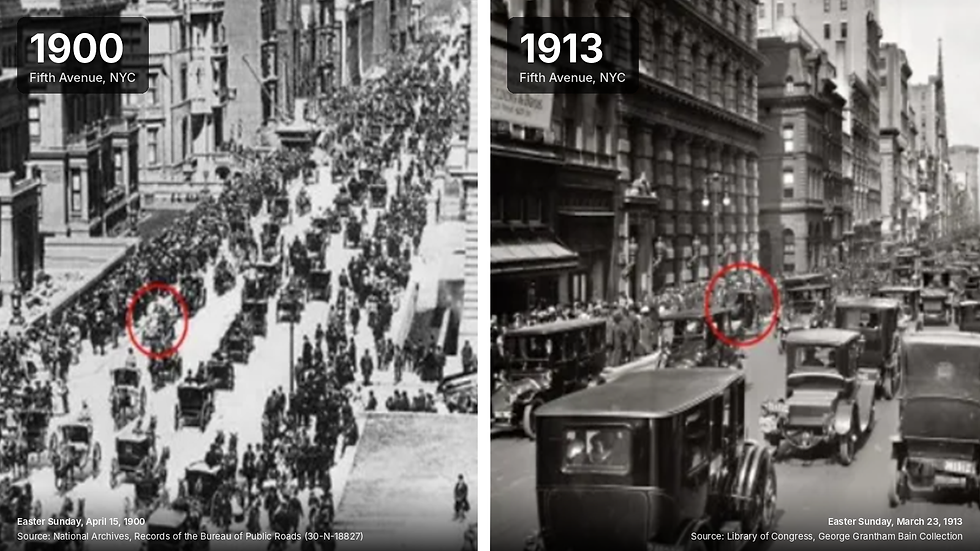
Everyone agrees AI is advancing faster than organizations can absorb it, BUT ...


As McKinsey & Company and others have noted, one compelling way to visualize this is as a widening gap between AI capability and human capability. The implication is clear: investing in people is at least as important (arguably more) as investing in technology.
BUT capability is only part of the story. Employees are already experimenting, learning, and finding ways to integrate AI into their work. The bigger challenge is whether organizations create the conditions for that capability to translate into everyday practice.
I wrote about this last year in Work Design, arguing that “quiet cracking” is the human signal of this imbalance. We’re pouring billions into AI capability while millions of employees remain trapped in work systems that haven’t caught up. That’s what happens when we upgrade the tools but not the way work and rewards are structured
Incentives dictate behaviors.
If we continue to reward incremental improvements, optimize for marginal efficiency gains, and measure success through legacy performance metrics, AI will simply reinforce the way we already work. In that environment, the safest move is to use AI to do the same work a little faster, not to question the work itself.
This is the classic “paving the cow path” risk.
The organizations that create outsized value use AI as a trigger to redesign workflows, rethink decision‑making, and realign incentives around new ways of working. McKinsey’s AI research shows that the highest performers are “reinventors” who redesign roles, workflows, and operating models around AI instead of just bolting tools onto legacy processes.
Of course, reinventing your operating model is easier said than done. It means changing how work flows across teams, where decisions get made, and how partners plug into your value chain, not just publishing a new AI policy.
So the more important questions become: Are we redesigning work around AI, or bolting AI onto legacy workflows? Do our incentives encourage experimentation, or punish deviation from the established process? Have we given employees explicit permission to challenge and rewrite existing ways of working? Are we measuring AI usage and impact, or simply tracking training completion?
The real progression is:
Technology → What AI makes possible.
Capability → What people know and can do with it.
Adoption → What people actually do differently, and how consistently.
Transformation → How the organization rewires workflows, decisions, and incentives around that new behavior.
Most organizations celebrate at the first two stages. Competitive advantage emerges at the last two.
Until next time,
Ram
—
Ram Srinivasan
MIT Alum | Author, The Conscious Machine | Global Future of Work and AI Adoption Leader published in Business Insider, Fortune, Harvard Business Review, MIT Executive Viewpoints and more.
—
A Message From Ram:
My mission is to illuminate the path toward humanity's exponential future. If you're a leader, innovator, or changemaker passionate about leveraging breakthrough technologies to create unprecedented positive impact, you're in the right place. If you know others who share this vision, please share these insights. Together, we can accelerate the trajectory of human progress.
Disclaimer:
Ram Srinivasan currently serves as an Innovation Strategist and Transformation Leader, authoring groundbreaking works including "The Conscious Machine" and the upcoming "The Substrate Shift."
All views expressed on "Substrate" and across all digital channels and social media platforms are strictly personal opinions and do not represent the official positions of any organizations or entities I am affiliated with, past or present. The content shared is for informational and inspirational purposes only. These perspectives are my own and should not be construed as professional, legal, financial, technical, or strategic advice. Any decisions made based on this information are solely the responsibility of the reader.
While I strive to ensure accuracy and timeliness in all communications, the rapid pace of technological change means that some information may become outdated. I encourage readers to conduct their own due diligence and seek appropriate professional advice for their specific circumstances.