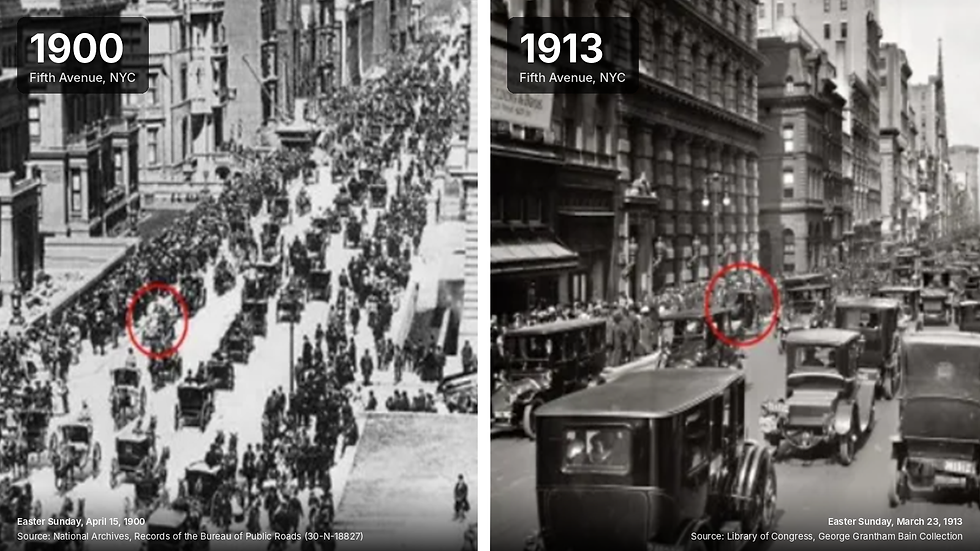
A snapshot of the substrate shift happening across the future of work.


In 1770, a machine appeared to do something extraordinary: it could play chess against humans. It was called the Mechanical Turk. Crowds watched as the wooden machine defeated skilled players.
Of course this was a trick. The chess-playing machine was operated by a human chess master hidden inside its cabinet.
More than 200 years later, Amazon borrowed the name for Mechanical Turk. Amazon's MTurk platform put human intelligence behind computers, paying people to perform the small tasks machines couldn't yet do.
And now, in 2026, Amazon is shutting it down.
The irony in the 256-year arc is hard to miss.
The original Turk fooled people into thinking a machine was intelligent. Amazon's Turk turned human intelligence into something that could be delivered through a machine. And now AI is becoming capable of doing many of the tasks those humans once performed.
This is a snapshot of the transition happening across the future of work.
AI is a substrate shift.
By substrate, I mean the underlying medium a system is built on and operates through.
Take farming as an example. Soil is the substrate: it holds the roots and is the medium through which plants access water and nutrients. Farming in soil is therefore designed around the constraints of soil including land, drainage, root systems, nutrient distribution and water.
Hydroponics changes the substrate. The plant no longer depends on soil, as water (more precisely a managed nutrient solution) becomes the medium through which nutrients are delivered directly to the roots.
The constraints change, so the system changes.
You wouldn't ask for the “top 10 hydroponics use cases for soil-based farming.” Once the substrate changes, you have to rethink the system itself.
The same applies to AI.
Our organizations, jobs and processes were built around a world where human intelligence was the primary substrate for cognitive work and machine intelligence was scarce.
Now intelligence can increasingly be instantiated in software, replicated at lower and lower marginal cost. It can be embedded directly into workflows.
The mistake is thinking about AI as another tool to bolt onto the existing system.
When the substrate changes, the world model must to change with it.
Beth Galetti's experience at Amazon offers a glimpse of what this can mean. After 25 years away from coding, AI gave her the ability to start building again, ultimately producing more than 100,000 lines of code.
At BMO, Mona Malone describes a similar shift: AI as a way of getting work done, giving people more capacity to adapt, learn and create.
A new substrate gives more people the ability to build. And when more people can build, we should expect entirely new systems, workflows and ways of working to emerge.
Intelligence is becoming a building material.
And we are only beginning to discover what we can build with it.
Until next time,
Ram
—
Ram Srinivasan
MIT Alum | Author, The Conscious Machine | Global Future of Work and AI Adoption Leader published in Business Insider, Fortune, Harvard Business Review, MIT Executive Viewpoints and more.
—
A Message From Ram:
My mission is to illuminate the path toward humanity's exponential future. If you're a leader, innovator, or changemaker passionate about leveraging breakthrough technologies to create unprecedented positive impact, you're in the right place. If you know others who share this vision, please share these insights. Together, we can accelerate the trajectory of human progress.
Disclaimer:
Ram Srinivasan currently serves as an Innovation Strategist and Transformation Leader, authoring groundbreaking works including "The Conscious Machine" and the upcoming "The Substrate Shift."
All views expressed on "Substrate" and across all digital channels and social media platforms are strictly personal opinions and do not represent the official positions of any organizations or entities I am affiliated with, past or present. The content shared is for informational and inspirational purposes only. These perspectives are my own and should not be construed as professional, legal, financial, technical, or strategic advice. Any decisions made based on this information are solely the responsibility of the reader.
While I strive to ensure accuracy and timeliness in all communications, the rapid pace of technological change means that some information may become outdated. I encourage readers to conduct their own due diligence and seek appropriate professional advice for their specific circumstances.