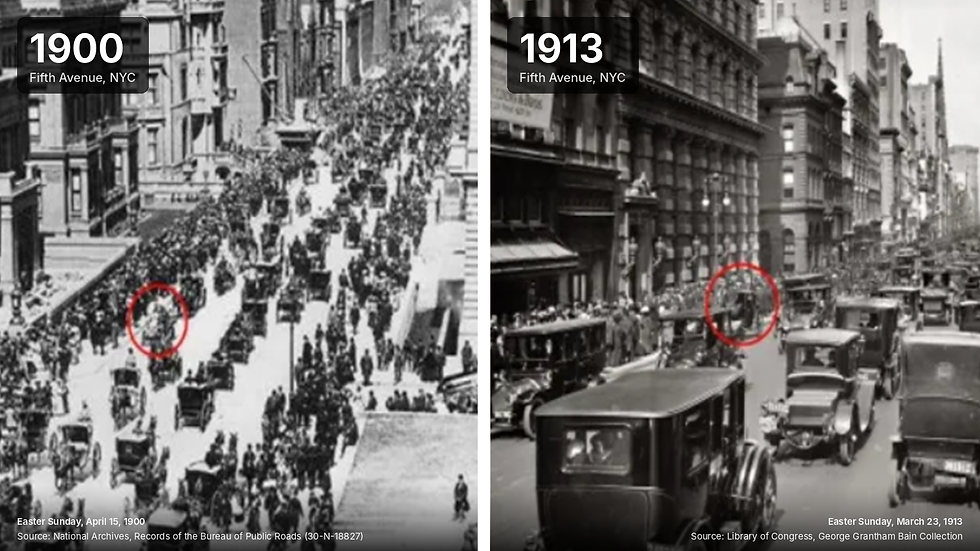
Exploration results in betterment of civilization in unpredictable ways.

The 2026 Nobel Prize in Physics is another reminder that some of the biggest breakthroughs often come from learning how to see what we couldn't see before.
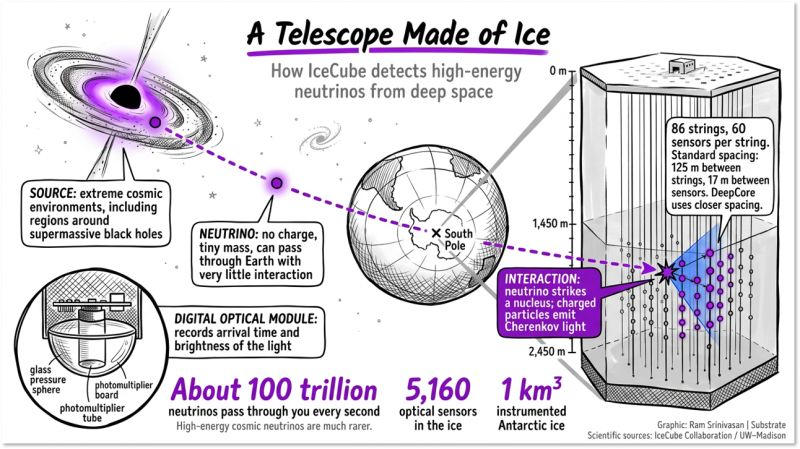
Every second, around 100 trillion tiny particles called neutrinos pass through your body and yet you don't feel a thing. In fact, most pass through the entire Earth without interacting with anything.
They are incredibly hard to detect BUT studying them offers us rich insight.
These "ghost particles" carry clues about some of the most extreme environments in the universe, including regions around supermassive black holes, exploding stars and more.
Professor Francis Halzen won this year's Nobel Prize in Physics for his decisive contributions to "IceCube" and the discovery of high-energy neutrinos of astrophysical origin.
His idea was audacious: what if we could use Antarctic ice to catch them?
The result is IceCube, a neutrino observatory at the South Pole. It is a cubic kilometre of ice, instrumented with 5,160 light sensors buried between about 1.5 and 2.5 kilometres beneath the surface.
Occasionally, a neutrino interacts with an atomic nucleus in the ice, producing charged particles that emit a faint flash of blue light. Sensors record the light, allowing scientists to estimate the neutrino's direction and energy. In some cases, combining these measurements with other astronomical observations helps identify its cosmic source.
Think about it, we have spent centuries observing the universe through light. Neutrinos give us another way to explore it. The exciting part is where this exploration might lead.
Exploration results in betterment of civilization in unpredictable ways.
Consider the internet. Research into connecting computers helped lay the foundations for a technology that transformed communication, commerce and everyday life. The space programme similarly advanced technologies that found applications far beyond spaceflight.
The value of scientific and engineering investment can extend FAR beyond its original purpose, through many discoveries and contributions over time.
Neutrino research may deepen our understanding of the universe and advance the sensors, instrumentation and data-analysis techniques needed to detect incredibly rare events. We cannot predict every application that might emerge.
What I find most exciting is the ingenuity behind this achievement. Halzen helped turn Antarctic ice into an entirely different kind of "telescope". Decades of scientific work, engineering and international collaboration made it possible.
In the age of AI, this is another testament to human imagination. As increasingly powerful tools expand what we can explore, progress will continue to grow from people asking questions that open entirely new frontiers.
Congratulations to Professor Halzen, the entire IceCube collaboration, and the global scientific community for continuing to push the boundaries of knowledge.
I can't wait to see what we discover next. Until next time, Ram —
Ram Srinivasan
MIT Alum | Author, The Conscious Machine | Global Future of Work and AI Adoption Leader published in Business Insider, Fortune, Harvard Business Review, MIT Executive Viewpoints and more.
—
A Message From Ram:
My mission is to illuminate the path toward humanity's exponential future. If you're a leader, innovator, or changemaker passionate about leveraging breakthrough technologies to create unprecedented positive impact, you're in the right place. If you know others who share this vision, please share these insights. Together, we can accelerate the trajectory of human progress.
Disclaimer:
Ram Srinivasan currently serves as an Innovation Strategist and Transformation Leader, authoring groundbreaking works including "The Conscious Machine" and the upcoming "The Substrate Shift."
All views expressed on "Substrate" and across all digital channels and social media platforms are strictly personal opinions and do not represent the official positions of any organizations or entities I am affiliated with, past or present. The content shared is for informational and inspirational purposes only. These perspectives are my own and should not be construed as professional, legal, financial, technical, or strategic advice. Any decisions made based on this information are solely the responsibility of the reader.
While I strive to ensure accuracy and timeliness in all communications, the rapid pace of technological change means that some information may become outdated. I encourage readers to conduct their own due diligence and seek appropriate professional advice for their specific circumstances.