I have been seeing more ads for AI productivity tools that look something like this -->


Why do you do what you do?
I have been seeing more ads for AI productivity tools that look something like this -->
A person is buried in email, meetings, spreadsheets, and presentations. They turn on "AI", the work disappears, and suddenly they are free to enjoy the afternoon.
But there is something missing from the advertisement: everyone else.
If AI lets me do my work twice as fast, my colleagues can too. So can my competitors, customers, and employer, which can raise expectations. Once the technology spreads, some of that productivity becomes the new baseline.
So what happens to the additional capacity? Some may become leisure, some higher output or lower prices, and some may make new products and services viable.
That points to a deeper question: is there actually a fixed amount of work?
We often talk about work as if there is a giant pile of tasks and machines will remove them one by one. But that isn't how work has worked.
In a 2024 study MIT's David Autor and his colleagues found that roughly 60% of U.S. employment in 2018 was in job specialties that did not exist in 1940. We kept inventing new things to build, solve, sell, explore, and experience.
Agriculture created the surplus for cities, specialization, trade, and institutions. The printing press made books abundant and expanded the circulation of knowledge. Industrialization made production scalable and created whole new systems of work around factories, infrastructure, and mass markets. We now have roughly one billion knowledge workers globally.
BUT, AI is different.
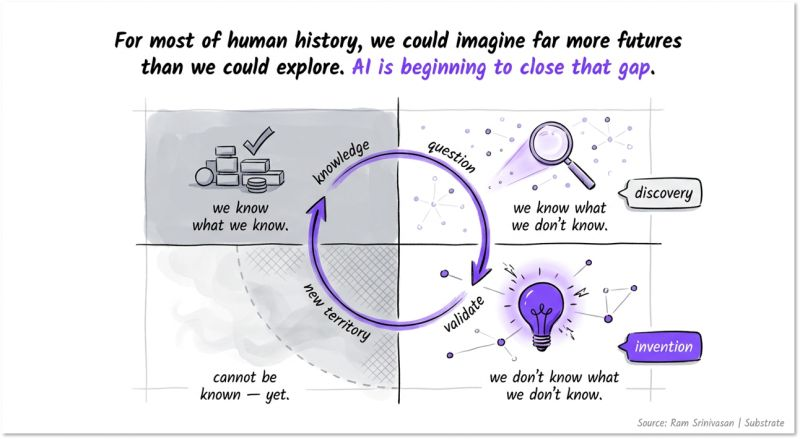
AI may make cognitive capability abundant and expand the number of ideas, systems, and possibilities worth pursuing.
Some of that work will be done by people. Some will be done by AI.
Every new possibility may NOT create a new human job. As the possibility space expands the question becomes where will human judgment, responsibility, relationships, and purpose remain valuable (and gain in value).
This also changes what a job means.
A job provides income, BUT also structure, identity, relationships, mastery, status, and contribution. Hal Gregersen and Roger Lehman distinguish between changing tasks and changing the roles through which people understand themselves.
The tasks change, the role evolves and that eventually leads from role to purpose.
As they say, “The two most important days in your life are the day you are born and the day you find out why.”
The better AI becomes at answering “How?”, the more important it becomes to decide what deserves to be done.
And if AI can increasingly help answer that question too, then the remaining question becomes FAR more personal: Why do you do what you do?
Until next time,
Ram
—
Ram Srinivasan
MIT Alum | Author, The Conscious Machine | Global Future of Work and AI Adoption Leader published in Business Insider, Fortune, Harvard Business Review, MIT Executive Viewpoints and more.
—
A Message From Ram:
My mission is to illuminate the path toward humanity's exponential future. If you're a leader, innovator, or changemaker passionate about leveraging breakthrough technologies to create unprecedented positive impact, you're in the right place. If you know others who share this vision, please share these insights. Together, we can accelerate the trajectory of human progress.
Disclaimer:
Ram Srinivasan currently serves as an Innovation Strategist and Transformation Leader, authoring groundbreaking works including "The Conscious Machine" and the upcoming "The Substrate Shift."
All views expressed on "Substrate" and across all digital channels and social media platforms are strictly personal opinions and do not represent the official positions of any organizations or entities I am affiliated with, past or present. The content shared is for informational and inspirational purposes only. These perspectives are my own and should not be construed as professional, legal, financial, technical, or strategic advice. Any decisions made based on this information are solely the responsibility of the reader.
While I strive to ensure accuracy and timeliness in all communications, the rapid pace of technological change means that some information may become outdated. I encourage readers to conduct their own due diligence and seek appropriate professional advice for their specific circumstances.