AI expands the number of worlds humans can consider before choosing.

"As AI gets better at execution, humans will still decide what problems are worth solving." We've heard this before and I have said versions of it myself. BUT there may be a more useful way to think about what AI is changing.
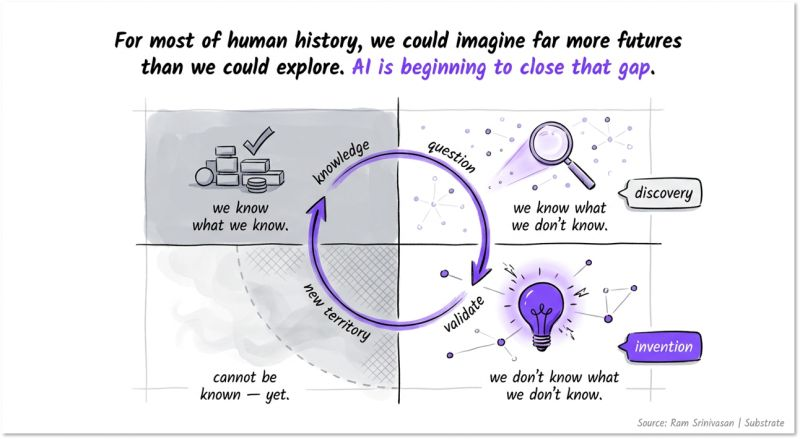
I see this in four buckets:
1\ Known knowns: we know what we know (== solved, could be improved).
2\ Known unknowns: we know what we don't know (== discovery).
3\ Unknown unknowns: we don't know what we don't know (== invention).
4\ Unknowables: things we cannot know, at least with the information, methods, or capabilities available to us today (~limits).
A recent result in mathematics is a useful example of a known unknown. Mathematicians knew what they were looking for. AI-assisted “search” helped navigate a vast space of possible mathematical constructions, identifying a promising route that researchers then developed and verified.
The resulting discovery is a solution to a decades old "inverse Galois problem". This is another fascinating example following closely on the heals of OpenAI's Navier-Stokes solution (pending further reviews).
Zoom out, beyond math.
Progress in many fields has been constrained partly by the cost of exploration: time, attention, experiments, simulations, and the ability to test combinations.
AI lowers that cost.
It can search more candidate solutions, generate more hypotheses, simulate more alternatives, and connect more distant ideas than human researchers or organizations could reasonably explore on their own.
So perhaps the important shift is the changing economics of moving between these categories:
2\ Known unknowns -> discovery
3\ Unknown unknowns -> invention
And there may be a loop here.
A new AI-generated possibility becomes a known question. Validation turns it into knowledge. That knowledge reveals new unexplored territory.
The cycle keeps going. That is a very different future of work.
What can we discover AND invent when exploring possibility spaces becomes dramatically cheaper?
We can increasingly do: Here are 1,000 plausible ways the future could work.
Explore them. Show me the surprising ones. Show me the ones that violate my assumptions. Show me the ones whose consequences I haven't considered.
Will this be perfect? Probably not. Will it accelerate discovery? We are already seeing the answer to that.
And that's where AI starts becoming something closer to a civilizational possibility-space explorer.
Humans still provide values, goals, constraints, taste, and judgment. But AI expands the number of worlds humans can consider before choosing.
And that may be the deeper transition we are witnessing.
____
Insights from Scientific American -> https://lnkd.in/gZ9FU4Um
Until next time,
Ram
—
Ram Srinivasan
MIT Alum | Author, The Conscious Machine | Global Future of Work and AI Adoption Leader published in Business Insider, Fortune, Harvard Business Review, MIT Executive Viewpoints and more.
—
A Message From Ram:
My mission is to illuminate the path toward humanity's exponential future. If you're a leader, innovator, or changemaker passionate about leveraging breakthrough technologies to create unprecedented positive impact, you're in the right place. If you know others who share this vision, please share these insights. Together, we can accelerate the trajectory of human progress.
Disclaimer:
Ram Srinivasan currently serves as an Innovation Strategist and Transformation Leader, authoring groundbreaking works including "The Conscious Machine" and the upcoming "The Substrate Shift."
All views expressed on "Substrate" and across all digital channels and social media platforms are strictly personal opinions and do not represent the official positions of any organizations or entities I am affiliated with, past or present. The content shared is for informational and inspirational purposes only. These perspectives are my own and should not be construed as professional, legal, financial, technical, or strategic advice. Any decisions made based on this information are solely the responsibility of the reader.
While I strive to ensure accuracy and timeliness in all communications, the rapid pace of technological change means that some information may become outdated. I encourage readers to conduct their own due diligence and seek appropriate professional advice for their specific circumstances.


