How many Chinese AI models are in your stack?
- Ram Srinivasan

- May 1
- 3 min read
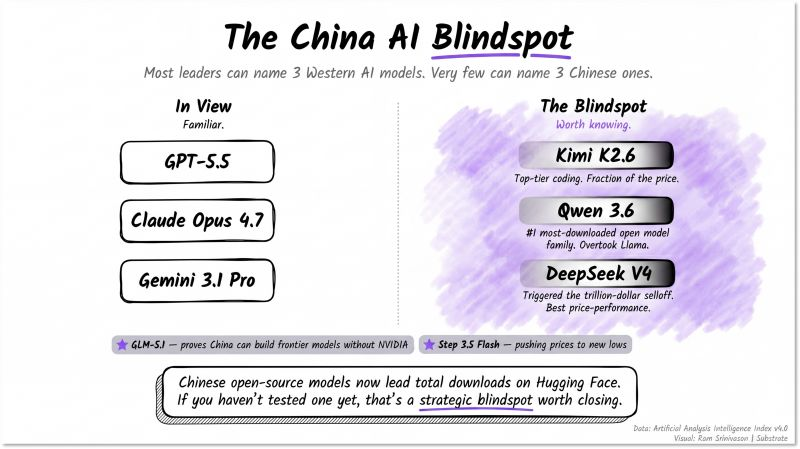
Most leaders I speak with can name three Western AI models. Very few can name three Chinese ones. That gap may start to cost teams real money this year.
The MIT Technology Review reported earlier this year that Chinese open‑source models have surpassed US models in total downloads.
The three names worth knowing:
1\ Kimi K2.6
Released April 20, 2026, this open model delivers coding performance in the same league as top Western systems at a much lower price.
2\ DeepSeek V4
Comes from the lab that triggered the trillion‑dollar selloff in early 2025. A very large, long‑context model that has become one of the best price‑performance options on the market.
3\ Qwen 3.6 (Alibaba Group).
Now the most‑downloaded open model family on Hugging Face, overtaking Meta’s Llama.
There's also GLM-5.1 which shows China can build leading models without relying on NVIDIA chips and Step 3.5 Flash wihch is pushing prices down to new lows.
This is a rich ecosystem we should be tracking closely.
The top three things leaders ask me about these models:
1\ “Can we run them locally?”
Yes, for a lot of everyday work. Smaller versions of DeepSeek and Qwen run on a well‑specced Mac (think recent Mac Mini or Mac Studio with extra memory). The very largest versions still need data‑center‑class hardware, but most day‑to‑day tasks don’t.
2\ “What about code injection and security?”
The instinct is to worry about where the model comes from. I’d argue you should worry more about how you wire it into your systems. Many of the real incidents so far come: compromised software dependencies, over‑empowered agents that can do too much, and prompts that trick the model into ignoring rules. None of these are specific to Chinese models.
3\ “How do we use these alongside Claude or GPT?”
Think “air traffic controller + fleet.” A frontier model (say Claude Opus 4.7 or GPT‑5.5) decides what needs deep reasoning and what doesn’t. Cheaper, often local models handle the bulk work. For the majority of tasks, those are “good enough” quality at a fraction of the cost.
Now consider this: on April 20, Apple announced that John Ternus, a hardware engineer, will succeed Tim Cook as CEO.
Around the same time, Apple completed an AI org remodel: its foundation model team moved closer to core software engineering, a new VP of AI arrived from Google’s Gemini group, Apple silicon is equipped to run models on‑device.
While OpenAI, Google, and Anthropic pour billions into data centers, Apple is betting the future of AI runs through tightly integrated devices. That bet only makes sense if frontier‑level capability is drifting toward the edge. The rise of powerful, low‑cost open‑weight models makes that bet plausible.
If you haven’t tested any of the Chinese models yet, that's strategic blindspot worth closing.
Until next time,
Ram
—
Ram Srinivasan
MIT Alum | Author, The Conscious Machine | Global Future of Work and AI Adoption Leader published in Business Insider, Fortune, Harvard Business Review, MIT Executive Viewpoints and more.
—
A Message From Ram:
My mission is to illuminate the path toward humanity's exponential future. If you're a leader, innovator, or changemaker passionate about leveraging breakthrough technologies to create unprecedented positive impact, you're in the right place. If you know others who share this vision, please share these insights. Together, we can accelerate the trajectory of human progress.
Disclaimer:
Ram Srinivasan currently serves as an Innovation Strategist and Transformation Leader, authoring groundbreaking works including "The Conscious Machine" and the upcoming "The Exponential Human."
All views expressed on "Substrate" and across all digital channels and social media platforms are strictly personal opinions and do not represent the official positions of any organizations or entities I am affiliated with, past or present. The content shared is for informational and inspirational purposes only. These perspectives are my own and should not be construed as professional, legal, financial, technical, or strategic advice. Any decisions made based on this information are solely the responsibility of the reader.
While I strive to ensure accuracy and timeliness in all communications, the rapid pace of technological change means that some information may become outdated. I encourage readers to conduct their own due diligence and seek appropriate professional advice for their specific circumstances.


