Your AI Will Fail. That's the Biggest Opportunity of the Decade.
- Ram Srinivasan

- Jun 29
- 6 min read
TL;DR: The strongest models are disappearing behind closed doors while the best open‑weights systems get cheaper in public. The result: fragile bets on single providers and three widening gaps: 1\ no plan B when a model goes dark, 2\ no ownership of the intelligence you depend on, and 3\ no defense against your team’s skill erosion. Each risk is a business opportunity in disguise.
This month the two most powerful AI models ever built shipped. But, almost nobody can touch them.
The frontier got MORE powerful and LESS available in the same week. OpenAI’s GPT-5.6 Sol shipped as a limited preview to a small set of government‑approved partners, with broader access promised. Anthropic’s Mythos went to a short list of vetted US organizations. Its guardrailed sibling, Fable 5, was abruptly suspended for all customers under a US export control directive, with no restart date announced.
Token-maxxing turned into token-rationing. Teams that spent freely a quarter ago are now auditing every call. Inside Microsoft, most internal Claude Code licenses for the Experiences + Devices division were canceled in May, with engineers told to move to GitHub Copilot CLI by June 30, the end of Microsoft’s fiscal year. Some startups have already rerouted traffic from premium frontier APIs like Claude Code to cheaper models such as DeepSeek R1, trading autonomous execution for lower per‑token costs and closer human oversight.
From China, the same month looked like Christmas. Open weight models got cheaper and sharper. On public benchmarks tracked by Stanford’s 2026 AI Index, the strongest Chinese systems now sit just behind the US frontier on many tasks, often at a fraction of the price per output token. On the biggest routing platforms, Chinese models already carry a substantive share of real usage. On price per output, they run several times cheaper. On the biggest routing platforms, Chinese models already carry a substantive share of real usage.
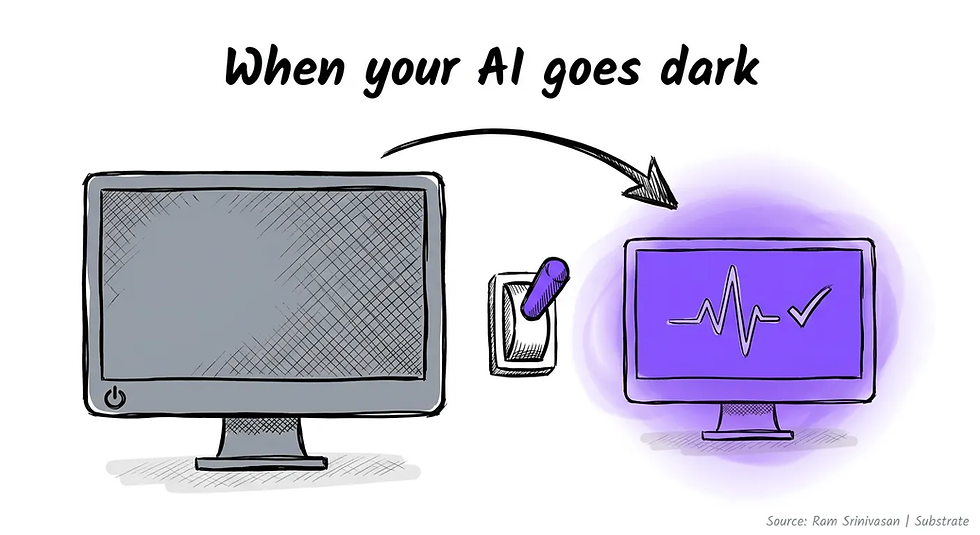
Here is the position most companies are in right now: you rent your intelligence from someone else, and the off switch lives in someone else’s building. You invested in backup power, you built database failover BUT do you have a plan for when your AI goes dark?
The answer is worth a fortune.
If your product, your workflow, or your internal stack runs on one provider, that provider’s bad day is now your bad day. One vendor becomes a point of failure, a chokepoint, and a bottleneck.
Savvy CIOs are already moving. They are rethinking spend and architecture together, and the first move is model routing: send each task to whichever model is good enough, fast enough, and cheap enough to clear the bar.
It started as a cost play. It has now turned into outage insurance.
When one model slows, degrades, shifts behavior, or drops offline, your traffic reroutes. Redundancy gets built before the incident, NOT during it. Many enterprise AI implementations lean almost entirely on a single frontier model. Leadership reads that as adoption. Read it again. It is exposure with a growth chart on top.

Clear the loudest objection out of the way first. Running an open model doesn’t make your data public. The weights are open, your data stays under your control. When the model runs on your own infrastructure, you can design it so nothing leaves your servers. The real question is narrower: who built the weights, and do you trust where they came from?
Many of the cheapest capable open models now come from Chinese providers. Open weights hand you control, and they hand the identical control to everyone else. The same model that runs inside your company runs inside an adversary’s, with no logging and no supervision on either side. So the decision stops being only cost and uptime. Data, trust, and jurisdiction join the table.
Nonetheless, MIT researchers noted that open models averaged 89.6% of closed-model performance but were usually able to close the gap within 13 weeks of a closed model’s initial release. That figure has dropped from +50% weeks just one year prior.

Open weight models just had their ChatGPT moment.
Take GLM 5.2 from China’s Z.ai. It’s a coding‑focused Mixture‑of‑Experts model with a usable 1‑million‑token context window, dual reasoning effort levels, and open weights under an MIT license. In independent testing, it tracks or beats popular closed models on long‑horizon coding when scaffolded well.
Owning the weights changes your leverage. No external rate limits, no outside kill switch and no one throttling you on their bad quarter.
To be clear, the weights are free, running them is the bill.
A model with hundreds of billions of parameters will not fit on a laptop. So you either buy serious hardware or pay someone to host it. Hosted open models still beat frontier APIs on price for plenty of workloads, but they come with their own token costs, infrastructure load, and operational risk. You still need engineers who can keep the stack breathing.
Even if you solve for outages and ownership, there’s one risk that doesn’t show up on a status page: what AI does to your team’s skills.

Some failures never reach a status page. When the AI disappears, the people who leaned on it hardest discover their own skills went soft while they weren’t looking.
In one medical study, endoscopists used AI to flag precancerous lesions. Once AI assistance became routine, physicians’ detection rate in non‑AI procedures fell by about a fifth. Skills softened as work shifted to the machine, and the decline only showed up once the AI was removed. Other experiments rhyme: give people AI support for a stretch, take it away, and many perform worse than people who never had it. Even when the system is wrong a meaningful share of the time, users keep accepting its errors at rates that should scare you.
People split into three groups. Centaurs divide the work and keep their own thinking switched on. Cyborgs work shoulder to shoulder with the tool and stay in command. Self automators hand the task over and rubber-stamp whatever comes back.
That last group is growing fast, and it is the group most likely to get hurt. In studies of professionals, a large minority slid into full self automation even while they knew they were being graded. Put the task just past the model’s ability and they lost to the people who kept reasoning for themselves.
The model made mistakes. The expensive failure came from the humans who stopped checking.
None of these risks are a reason to back away from AI. They’re a reason to treat it as core infrastructure and design for resilience, ownership, and human capability on purpose.
When electricity became infrastructure, the money was never only in generation.
It created electricians, inspectors, surge protectors, backup generators, maintenance crews, safety codes, and whole industries built around keeping the lights on.
AI is in that phase. The base layer exists but the support system around it barely does. That gap is wide open right now.
Someone designs the fallback plans. Someone decides which models a company can trust. Someone advises on how to reinvent and optimize. Someone teaches teams to use AI without losing their edge. Someone watches cognitive offload and skill erosion before they becomes liabilities.
The next time a major model goes dark, half the market will scramble. The other half will already own the plan, the routing, the trained teams, and the businesses built to serve everyone still scrambling.
Pick your half. Then go build it. Until next time,
Ram —
Ram Srinivasan
MIT Alum | Author, The Conscious Machine | Global Future of Work and AI Adoption Leader published in Business Insider, Fortune, Harvard Business Review, MIT Executive Viewpoints and more.
—
A Message From Ram:
My mission is to illuminate the path toward humanity's exponential future. If you're a leader, innovator, or changemaker passionate about leveraging breakthrough technologies to create unprecedented positive impact, you're in the right place. If you know others who share this vision, please share these insights. Together, we can accelerate the trajectory of human progress.
Disclaimer:
Ram Srinivasan currently serves as an Innovation Strategist and Transformation Leader, authoring groundbreaking works including "The Conscious Machine" and the upcoming "The Substrate Shift"
All views expressed on "Substrate" and across all digital channels and social media platforms are strictly personal opinions and do not represent the official positions of any organizations or entities I am affiliated with, past or present. The content shared is for informational and inspirational purposes only. These perspectives are my own and should not be construed as professional, legal, financial, technical, or strategic advice. Any decisions made based on this information are solely the responsibility of the reader.
While I strive to ensure accuracy and timeliness in all communications, the rapid pace of technological change means that some information may become outdated. I encourage readers to conduct their own due diligence and seek appropriate professional advice for their specific circumstances.


