top of page

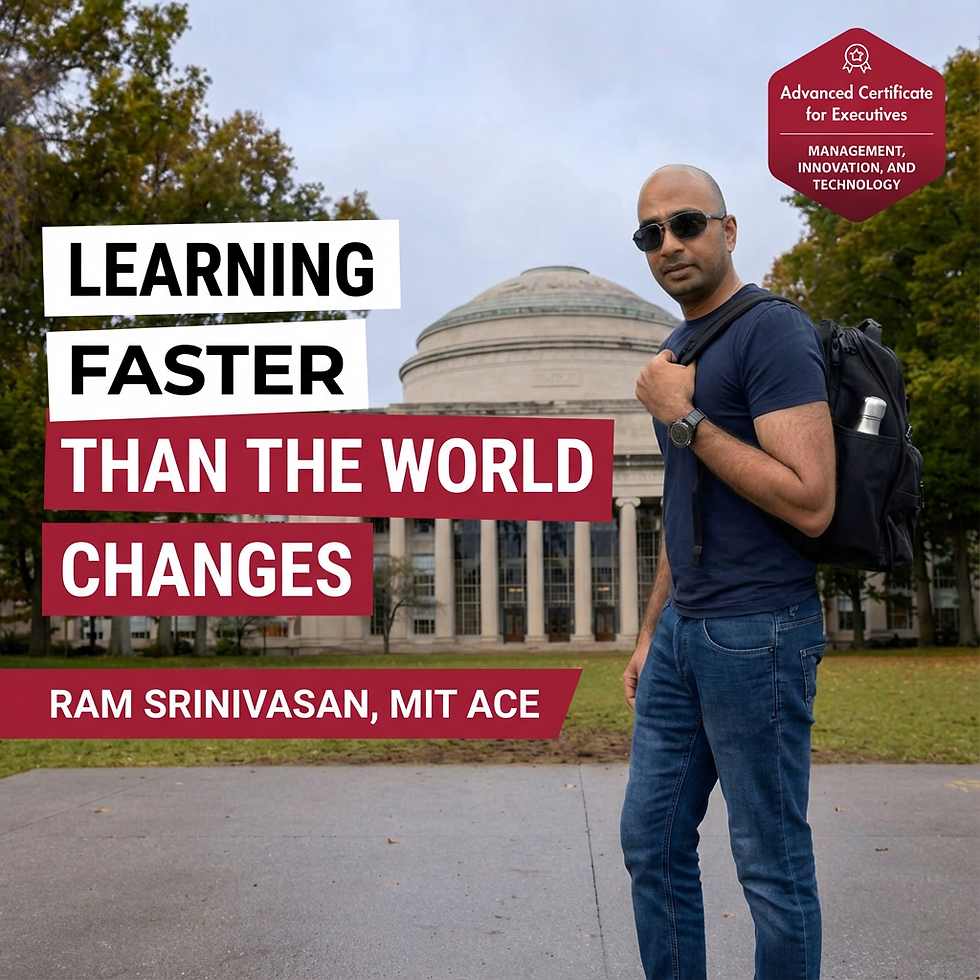
Learning Faster Than the World Changes

  • Writer: Ram Srinivasan
    Ram Srinivasan
  • 5 days ago
  • 5 min read
ree

How Do You Stay Ahead When Everything's Moving This Fast?


I get asked this question all the time. Usually over coffee, sometimes after a talk, occasionally in a LinkedIn DM from someone who's feeling the acceleration and isn't sure how to keep up. My answer surprises people: I go back to school. Not for credentials. For pattern recognition.

Going back to school @MIT isn't a vacation; it's the classic experience of "drinking from the firehose." The volume is overwhelming by design, forcing you to filter signal from noise immediately.

The modern business landscape feels exactly the same. We're operating at the convergence of massive exponential forces: AI, reconfiguration of human workflows, and the critical need for system resilience.

Between 2015 and 2023, I have cycled through several MIT and MIT Executive Education Programs. People assume I'm collecting credentials. I'm not. I'm collecting lenses. Here are three frameworks that rewired how I think about strategy.

1\ The Absence of Data is Data

In decision-making, we obsess over the data we have. True rigor demands we obsess over the data we lack.


The 1986 Space Shuttle Challenger disaster illustrates this perfectly. On launch morning, temperatures were freezing approx. 30°F, colder than any previous launch. Engineers raised concerns about O-ring performance in cold weather. The decision team reviewed available analysis: a scatter plot showing temperatures where O-ring failures had occurred across 7 previous launches. Failures appeared at various temperatures. The pattern wasn't clear.


The flaw was the missing data. They hadn't plotted the 17 flights where no failure occurred.


All work at MIT is hands on. Beyond learning about the facts of the case, we rebuilt the analysis using logistic regression, treating all 24 past launches as 120 independent data points (5 O-rings per launch). When you include the full dataset, successes and failures, the signal becomes clear. For every degree the temperature drops, the odds of failure increase significantly; high enough that the launch almost certainly should have been postponed.


The lesson for AI adoption: If we train predictive models only on visible metrics, we build fragility into our strategy. We must analyze the invisible.


2\ There Are No Side Effects, Only Effects

We often assume complex problems require trade-offs: to get more of X, we must give up Y. Systems thinking challenges that binary. Professor John Sterman teaches a fundamental truth: "There are no side effects—only effects."

We tested this live with the famous "Beer Game" simulation. It demonstrates how small shifts in consumer demand ripple up the supply chain to create massive instability: the Bullwhip Effect. It proves that structural design, not individual performance, often dictates outcomes.

We see this playing out with Return to Office (RTO) mandates. Many leaders view RTO as a simple lever: pull it, get collaboration. But a systems thinker looks for the cascading effects. A policy intended to boost collaboration (reinforcing loop) might simultaneously trigger attrition or reduced diversity (balancing loops that undermine the original goal).

We label consequences we didn't foresee as "side effects" to distance ourselves from responsibility. A systems thinker knows these aren't bugs, they are features of the system we designed.


3\ The Periodic Table of Digital Elements

At MIT, "Hack" doesn't mean breaking into a bank. It means a clever, technically sophisticated solution to a problem. The application of ingenuity to overcome constraints.


Algorithmic Business Thinking (ABT) applies that "Hacker Ethic" to corporate strategy. One of the most useful tools: the Periodic Table of Digital Elements. Just as chemists use the periodic table to understand how atoms bond to create matter, digital leaders use this table to understand how digital components bond to create value. We break business problems down into elemental units: sensors, algorithms, APIs, human judgment.


We cannot tackle "Digital Transformation" as a monolithic goal. We must decompose it. By isolating these elements, we can see exactly where a machine should take the load and where a human must take the lead.


If we cannot articulate the algorithm of our own business logic, we cannot automate it.


Seeing the Future Before It Arrives


Here's the other thing about MIT: you get to experience what's coming before the rest of the world knows it's coming. I learned about neural networks, XR, Robotics, Quantum Computing and more, long before any of these concepts were mainstream.


That's what continuous learning at MIT gives you: early access to the patterns that will matter in years ahead. Not predictions. Direct experience.


MIT’s motto is Mens et Manus—Mind and Hand. Theory without the ability to build is useless.


So, when people ask how I stay ahead, here's what I tell them:

  • You don't predict the future. You go where it's being built and learn the patterns before they're obvious.

  • You work through case studies that teach you to question whether you're analyzing complete data.

  • You learn system dynamics so you can see the structures beneath the symptoms.

  • You experience emerging technologies before they scale so you recognize the inflection points.

  • Importantly, build a community of peers who are wrestling with the same inflection points, creating a network that compounds learning long after the program ends.


None of this guarantees better answers. But it consistently produces better questions.

And in a world moving this fast, the ability to ask better questions earlier than everyone else, that's the edge.


— Ram Srinivasan MIT Alum | Author, The Conscious Machine | Global AI Adoption Leader.

Published in Business InsiderFortune, Harvard Business Review, MIT Executive Viewpoints and more.


A Message From Ram:

My mission is to illuminate the path toward humanity's exponential future. If you're a leader, innovator, or changemaker passionate about leveraging breakthrough technologies to create unprecedented positive impact, you're in the right place. If you know others who share this vision, please share these insights. Together, we can accelerate the trajectory of human progress.


Disclaimer:

Ram Srinivasan currently serves as an Innovation Strategist and Transformation Leader, authoring groundbreaking works including "The Conscious Machine" and the upcoming "The Exponential Human."


All views expressed on "Explained Weekly," the "ConvergeX Podcast," and across all digital channels and social media platforms are strictly personal opinions and do not represent the official positions of any organizations or entities I am affiliated with, past or present. The content shared is for informational and inspirational purposes only. These perspectives are my own and should not be construed as professional, legal, financial, technical, or strategic advice. Any decisions made based on this information are solely the responsibility of the reader.


While I strive to ensure accuracy and timeliness in all communications, the rapid pace of technological change means that some information may become outdated. I encourage readers to conduct their own due diligence and seek appropriate professional advice for their specific circumstances.


bottom of page